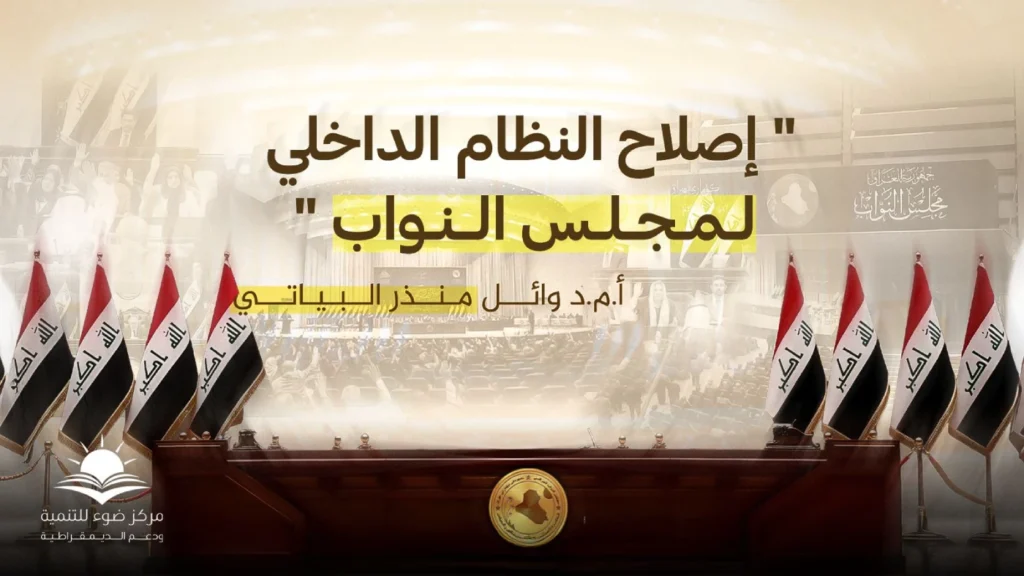
The 2005 Constitution focused on the democratic idea when defining the Republic of Iraq in Article One thereof, and affirmed that the exercise of authority shall not take place except through the constitutional institutions derived from the Constitution, and that its circulation shall be linked to democratic means enshrined therein, as a reaction against dictatorial and authoritarian states. Hence, it was necessary, to complete this form, that there be a clear regulation of the right to the existence of a parliamentary political opposition. If the right to freedom of expression and recognition of difference is a fundamental principle, it cannot be doubted that reliance upon it to acknowledge the existence of the idea of opposition is essential. However, recognition at the constitutional level has become more necessary to move beyond the idea of the presence of all political forces within authority, given what the existence of a legal opposition provides in terms of strength in evaluating government performance, activating the work of the legislative authority, and preventing deviation in its conduct. Thus, constitutional recognition of difference and diversity through clear legal provisions gives landmarks to opposition within parliament rights that may not be diminished, and duties that can be relied upon in activating legislative and oversight work by its members, in a manner that reflects positively on the performance of the executive authority, leading to achieving dynamism of work within constitutional institutions. Hence, it was necessary to think about enacting clear texts that recognize the right to parliamentary opposition within clear legal frameworks.
First: The extent of the importance of recognizing the idea of parliamentary opposition.
The emergence of the idea of opposition dates back generally to the period in which authority began to be confined within ancient societies. For every system there exists—regardless of its compatibility with aspirations and desires of society—those who differ with it in method or objectives, who seek to manage society, and the recognition of this division and plurality of opinions constituted an important role in confronting it to curb deviation in cases of tyranny. Parliamentary opposition has played a major role in ensuring the development of the nature of governance in parliamentary systems, as its existence has been recognized in a known manner with great importance in managing the process of governance away from violence.
Recognition of the right to opposition constitutes an essential guarantee and a legal framework for its legitimate existence, which positively reflects on the freedom of the political system, since there is no political freedom without it. A sound understanding of democracy is not limited to majority rule alone; rather, it should work to provide constitutional guarantees for the minority, through creating a kind of balance within the representative councils. The importance of recognizing the existence of parliamentary opposition is demonstrated from several aspects, namely:
Guaranteeing the peacefulness of political action: Parliamentary opposition is characterized by being a political act of a peaceful nature; its activity within the legislative institution keeps it away from violence as a means to reach authority. Rather, its work is based on monitoring errors and shortcomings in the work of the majority government in a manner that enhances its position in competition to reach authority; opposition would almost be rendered meaningless were it not for the tools it possesses that enable it to represent interests intersecting with the majority.
Publicity in the face of the majority: As parties that do not obtain the required majority to form the government practice their role within the representative councils, political activity appears publicly in the elected institution in terms of persons, mechanisms of work, and composition; this contributes to eliminating the sources of secret political action that always appear in non-democratic systems.
Guaranteeing the exercise of rights and public freedoms: The presence of opposition political parties constitutes oversight of the government’s work, through which it is possible to defend human rights and freedoms, and to limit government tyranny in legislation in a manner that diminishes individual rights.
Guaranteeing the idea of alternation: By presenting the possibility of alternation, the opposition’s work is not limited to criticism and dissatisfaction with governmental actions to increase its strength in elections; rather, it thinks politically and proposes alternatives, and presents itself as an alternative capable of implementation when called upon to form the government.
Second: The functions of parliamentary opposition.
The existence of opposition in political life constitutes a fundamental component without which a democratic system cannot be imagined. In addition to participation in the function of legislation and oversight, the most prominent role of parties that do not participate in government appears through the functions they exercise, which are represented in:
Political stability: The existence of parliamentary opposition helps to make political competition and struggle within the legislative institution a means of transferring it to society, thus preventing the emergence of societal conflict or divergent trends, or opinions that do not believe in rotation according to democratic frameworks, which threatens peaceful alternation and stability of the state.
Presenting the alternative: Parliamentary opposition works to present its understanding and programs as an alternative to the existing government, through the criticism it presents and the proposals and policies it seeks to reach support for and adopt. It also works to draw the limits of agreement and disagreement with what governments present, as it contributes to monitoring authority and forming an opposing authority that enables it to achieve political alternation.
Ensuring political practice of public freedoms: As for the role played by parties in raising political awareness among individuals, through what they practice of oversight and expression of opinions opposing the ruling majority, this leads to forming public opinion that represents the desires of individuals and what revolves in their minds, through drawing attention to these by the parties and presenting them through the use of various media outlets.
Evaluating the work of the government: Its existence works to confront governmental deviations and evaluate them, through the oversight means practiced by members of councils of deputies, which result from competition in order to reach authority. Competition has an important positive effect, which is competition to serve the public interest.
Third: The rights that can be granted to parliamentary opposition.
The Constitution of the Republic of Iraq for the year 2005 recognized political pluralism in Article (39/First), which stipulated the freedom to establish associations and political parties, and to join them, and this shall be regulated by law. This is what indicates the constitutional legislator’s adoption of the democratic approach to managing the political system in the article that specified the nature of the political system by stating: “The Republic of Iraq is a single federal, independent, and fully sovereign state,” as this constitution guaranteed the unity of Iraq. It also affirmed that the system of governance is republican, representative (parliamentary), democratic, and this constitution guaranteed the unity of Iraq. It also proved that the process of circulation of authority shall not take place except through the means stipulated in the Constitution in Article (6), through the participation of parties that are consistent with the democratic idea, and prohibited parties and organizations that adopt violence as a means to reach authority, and as presented by the Baath Party.
The introduction, pursuant to the provisions of Article (7/First), stipulated the prohibition of any entity or approach that adopts racism, terrorism, takfir, sectarian cleansing, or incites, glorifies, promotes, or justifies it, and the Baath Party, Saddam’s Baath in Iraq and its symbols, under any name whatsoever, and it is not permissible for that to be part of political pluralism in Iraq, and this shall be regulated by law.
If the Constitution did not include any explicit text referring to the idea of parliamentary opposition, then it includes a number of rights that are exercised by members of the Council of Representatives in their personal capacity or through parliamentary committees, without distinction between those belonging to the party or parties that form the government or those that are outside the executive authority, including what relates to (legislative initiative); where ten deputies or one of the parliamentary committees have the right to submit proposals of laws or amendments thereto, provided that they do not include financial obligations or harm the work of the executive authority or prejudice the independence of the judiciary. As for what relates to the (oversight field), members of the Council of Representatives have a pivotal role in monitoring the performance of the executive authority, its policies, plans, budgets, and programs, and they exercise this role through several tools granted to them by the Constitution and the internal system of the Council of Representatives, which are: the question, raising a topic for general discussion, interrogation, and membership in investigative committees (parliamentary). In contrast, we find a need to establish an integrated framework that ensures activating the work of parliamentary opposition without depriving the parliamentary work tools from opposition deputies on the pretext of not obtaining a numerical majority within the Council. This can be decided through several tools in the internal system, namely:
Activating participation in calling for convening the Council: where the Constitution stipulated the possibility of calling to convene a session of the Council of Representatives by several parties, including members of the Council of Representatives, and upon the submission of a request by fifty (50) deputies to hold an extraordinary session; to strengthen the position of parliamentary opposition, there is a need to grant the parliamentary opposition bloc the right to call for convening the Council under easier conditions than the rest of the constitutionally stipulated entities, with the need to stipulate texts that set the minimum limit for the possibility of forming a parliamentary bloc at no less than ten members.
Participation in determining the agenda of the Council’s work: the Presidency of the Council of Representatives is the sole body that has, pursuant to the internal system, the authority to determine the topics to be included in the agenda, which means excluding the participation of the opposition in determining the works that are presented to the Council, which leads to not presenting the issues that the opposition seeks to raise. This requires amending the internal system in a manner that ensures the possibility of holding one session per month as a minimum that includes an agenda prepared in advance by the parliamentary opposition blocs, which is what is known as opposition days, to ensure the presentation of opinions and viewpoints away from the control of the Presidency of the Council.
Adopting the principle of proportionality in exercising the right to speak within sessions: the right to speak is linked to forming parliamentary blocs, by considering them the places in which the right to express opinions and discuss and make decisions is exercised. Accordingly, a protective mechanism should be adopted to ensure the availability of the right to speak on the basis of the proportion of representation within the Council, which allows for imposing types of balance in work within the legislative institution, in a manner that prevents the dominance of the majority members over the rights of the minority to participation in discussion and debate during the convening of sessions.
Representation of the opposition in the organizational structure of the Council of Representatives: representation can be envisioned in two aspects:
a. The Presidency of the Council of Representatives: the parliamentary opposition may be granted the right to participate in it, if the Deputy Speaker is from the second largest bloc or from one of the minority blocs, to ensure that the decision-making authority is not monopolized by the majority. If this matter is faced by opposition from the majority due to its fear of the opposition parties controlling the work of the Council.
b. Parliamentary committees: since the basis of the work of a member of the Council of Representatives is the result of the efforts of parliamentary committees, as evidenced by discussions or decision-making in sessions, or the preparation of committees for ideas and draft laws. Therefore, there is no need to grant opposition parties the right to chair committees (obligatory committees, government performance oversight committees, human rights committees), which are considered among the most important manifestations through which the position of parliamentary opposition can be developed, as well as the development of its oversight performance in a manner that reflects positively on the development of the performance of the executive authority and governmental work in general. It should also be ensured that there is proportional representation in the remaining committees of the Council without discrimination on the basis of the nature of the committee’s work or its importance, taking into account the proportion of the number of seats.
Representation in parliamentary diplomatic delegations: there should be a role for the opposition in parliamentary diplomatic work, through ensuring fair and equitable representation for the opposition in any official delegation or diplomatic protocol, which ensures the presence of different opinions and trends in representing the legislative authority, and not restricting representation to members of the majority parties.
In conclusion, it can be said that recognition of political pluralism, if it is a necessary requirement for the establishment of a democratic system, then the adoption of the idea of the existence of an opposition and a majority has become a necessity to activate the work of the Council of Representatives. This reinforces recognition of the right to parliamentary opposition in a manner that grants it a position within the political system to exercise its functions, tasks, and roles under a legislative umbrella, enhances its status, and activates its role in oversight and voting.
Hence, there is a need to work on amending the internal system of the Council of Representatives and its law in a manner that includes the addition of texts granting parliamentary opposition the status through which it can significantly contribute to stabilizing the political system, by activating its contribution to drafting laws and activating its role in the Council, and by working on determining legal texts to activate the role of parliamentary blocs within the Council of Representatives through specifying texts governing the mechanism of their formation and determining their position as either majority or parliamentary opposition, in order to constitutionally enshrine the right to opposition in future constitutional amendments.