
Professor Dr. Abdul Hamid Al-Moussawi
College of Imam Al-Kadhim (peace be upon him) University – Department of Political Science.
Iraq and the policy of balance and caution in a time of transformations and regional turmoil
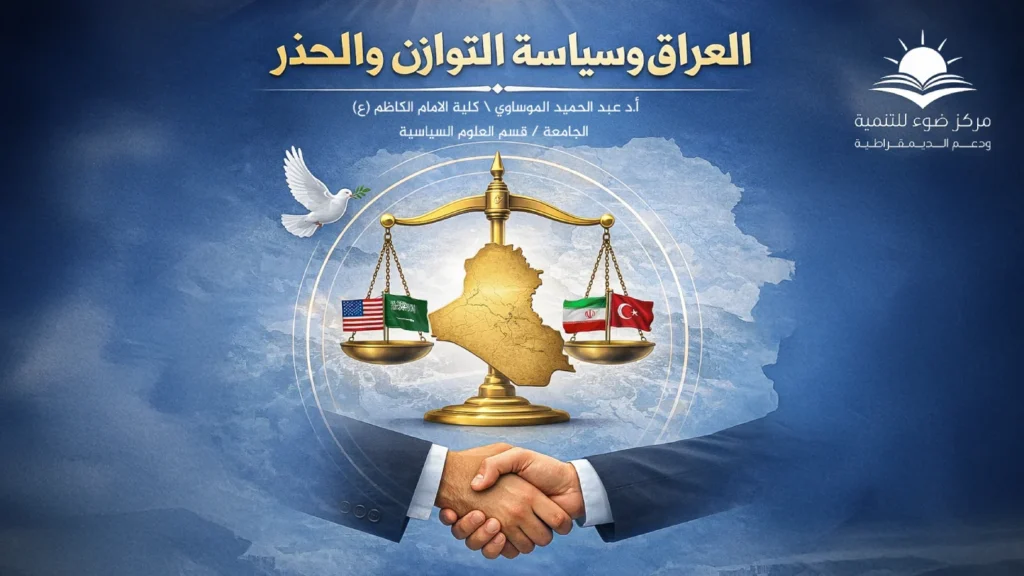
The region surrounding Iraq is witnessing an escalating state of turmoil and instability, as a result of political and military conflicts and the overlapping of regional and international interests. Amid the pressures of regional and international competition and the entanglement of security and political files, the Iraqi state seeks to adopt a policy based on balance and caution, as an approach aimed at neutralizing the country from the repercussions of surrounding conflicts and preserving its internal stability and national sovereignty. To what extent has Iraq succeeded in employing a policy of balance and caution to manage its position at the heart of regional turmoil? And what are the constraints and challenges facing this policy in light of the rapid transformations in the region?
Within a regional and strategic environment characterized by volatility and uncertainty, Iraq emerges as a state seeking to neutralize itself from the waves of turmoil affecting its immediate surroundings, particularly in Syria, Lebanon, Iran, and Israel. Aware of the sensitivity of regional balances and the risks of increasing Israeli involvement, Iraq works to pursue a cautious balance policy that maintains a safe distance between Tehran and Washington. After long years of international isolation, Iraq aspires to invest in the relative improvement in security stability during recent years, which has provided a wider margin for regional and international re-engagement. In this context, the ruling elites bet on the existing political reality to provide opportunities for economic growth that respond to the aspirations of the youth segment, while avoiding engagement in deep political reforms demanded by the “October protests.”[1] In the face of major political transformations in both Syria and Lebanon, the Iraqi government hopes to contain the repercussions of the post-change phase in Damascus, while cautiously and confusedly monitoring the repositioning path adopted by the new Syrian government and the accompanying counter-effects on the region.
Rebuilding bridges of rapprochement with neighboring countries
At the regional level, the Iraqi government is moving toward adopting an active approach based on normalizing relations with neighboring countries, investing the relative stability that followed the elections, and seeking to employ it to open new developmental horizons, especially after the recent electoral entitlements. In this context, organizing the Arab League Summit in Baghdad on May 17, 2025, constituted an attempt to revive Iraq’s Arab role and enhance its regional presence, in a manner reminiscent of the efforts of the government of Mr. (Nouri al-Maliki) in 2012, benefiting from the regional developmental momentum led by the Kingdom of Saudi Arabia under the leadership of Prince (Mohammed bin Salman). However, the most evident progress was achieved in relations with Turkey, with what this carries of realistic developmental opportunities for Iraq, despite the historical complexity that has characterized relations between Baghdad and Ankara. Since 2003, Iraq has constituted a central arena for Turkish policy movements and its regional ambitions[2], yet transformations in the regional context, particularly developments in the Syrian file, pushed Ankara to adopt a more cautious and precise approach in its dealings with Baghdad.
Since June 2023, Turkey began sending clearer messages reflecting its desire to open a new page with Baghdad and to seek building an organized institutional framework for bilateral cooperation. This trend was crowned by the visit of Turkish President (Recep Tayyip Erdoğan) to Iraq on April 22, 2024, which constituted a practical indicator of this shift. This path reflects Ankara’s awareness of the importance of Iraq’s stability and security as a decisive factor in the stability of the region in general, especially in light of the Iraqi government’s efforts to neutralize the repercussions of the Israeli counter military attack and the rapid developments in the Syrian arena[3].
From the Turkish perspective, this approach represents an attempt to strengthen relations with a neighboring state of significant geopolitical weight, particularly in light of Iraq’s oil resources, which are of strategic importance to Turkey. Accordingly, Ankara’s interest in Baghdad’s stability has long been linked to its alignment with its national interests. President (Erdoğan) emphasized, during his official visit to Baghdad in April 2024, that consolidating and normalizing relations is an urgent necessity in light of the state of turmoil witnessed by the Middle East region[4].
In return, the Iraqi government seeks to employ this Turkish shift to its advantage, despite the continuation of disagreements between the two sides regarding Turkish military operations in northern Iraq against elements of the Kurdistan Workers’ Party, particularly in the Qandil Mountains areas, although these disagreements remain within containable limits. In this context, and in view of the security challenges facing Baghdad in extending its full sovereignty, in addition to the complexity of its relationship with the Kurdistan Region, Ankara was waiting for Iraq to take an official step in the form of classifying the Kurdistan Workers’ Party as a terrorist organization and taking practical measures to eliminate its presence inside Iraqi territory[5].
In response, and within the framework of demonstrating goodwill toward Ankara, the Iraqi government in March 2024 classified the Kurdistan Workers’ Party as a “banned organization,” a step that was met with clear Turkish welcome. This development was followed by the signing of a series of security agreements between the two countries to combat terrorism, which included the establishment of joint coordination and cooperation centers in both Baghdad and Bashiqa.
Under these understandings, Turkey continued its military operations against party elements in northern Iraq, while strengthening coordination mechanisms with Baghdad based on the memorandum of understanding on military and security cooperation and counterterrorism. The agreement signed by Turkish Defense Minister Mr. (Yaşar Güler) and his Iraqi counterpart Mr. (Thabit al-Abbasi), during the fourth meeting of the High-Level Security Cooperation Mechanism in Ankara in August 2024, came to frame this type of intervention and joint coordination[6].
In this context, the announcement by the Kurdistan Workers’ Party on May 12, 2025, of dissolving its organization and ending its armed activity constituted a qualitative development that strengthened the general path toward calming security conditions and improving bilateral relations between Iraq and Turkey[7], a path likely to extend to areas of economic cooperation and joint development.
Within Iraq’s efforts to accelerate the path of economic development and enhance its stability, Turkey emerges as a pivotal partner. The visit of Prime Minister Mr. (Mohammed Shia’ al-Sudani) to Ankara on May 8, 2025, constituted an important station in the course of Iraqi–Turkish relations, as both sides affirmed the importance of expanding security and economic cooperation. The visit resulted in the signing of a package of agreements in multiple sectors to enhance trade exchange, given that Iraq is one of Turkey’s most prominent economic partners, with the volume of exchange between the two countries reaching approximately (20) billion dollars. In addition to working to remove obstacles to bilateral trade, the two sides renewed their support for the strategic (Development Road 25) project[8], with emphasis on accelerating its implementation pace. The Turkish approach reflects a firm conviction in the necessity of improving bilateral relations and investing economic cooperation opportunities as an entry point to overcome regional turmoil and achieve mutual gains.
Conversely, the arrival of a figure with a “jihadist” past to power in Damascus on December 8, 2024, constituted a surprising development that disrupted Iraqi calculations[9]. This man “al-Joulani” had previously participated in resisting the American intervention in 2003 and spent time in Iraqi prisons, before becoming associated with ISIS. This political transformation in Syria led to the outbreak of what was described as the “Sunni revolution,” which raised deep concern among the Iraqi political elite, despite Baghdad’s quick adoption of a conciliatory discourse toward the new Syrian authorities[10].
The hostility between Baghdad and Damascus dates back to historical roots, but it renewed sharply after 2003, against the backdrop of the positions of the former Syrian regime, particularly the policies of President (Bashar al-Assad) toward fleeing Iraqi Baathists, jihadist groups, and ISIS. The rapid fall of the Syrian Baath regime in December 2024 led to a state of panic in Iraq[11], centered primarily around the potential security repercussions on the Iraqi interior.
Iraqi authorities, including religious references, rushed to prevent the repetition of the scenario of mobilizing factions to defend shrines in Damascus, particularly the shrine of (Sayyida Zaynab), as happened after the fall of Mosul, calling for restraint. After receiving assurances from the new leadership in Damascus regarding the protection of holy sites and combating ISIS, Baghdad embarked on a cautious rapprochement approach with the new Syrian regime, while maintaining a reserved distance due to the “jihadist” past of its leadership and the nature of its initial transformations toward a centralized state model, which contradicts the decentralized model adopted in Iraq[12].
Nevertheless, pragmatism prevailed in this rapprochement, as priority was given to securing the shared borders, particularly the (al-Bukamal) crossing, and addressing the file of detained foreign fighters. High-level contacts were indeed conducted to enhance security coordination, but the persistence of mistrust quickly constrained these efforts.
This was clearly manifested during the Arab League Summit held in Baghdad in May 2025, when the Iraqi government, as the host state, extended an invitation to the new Syrian authorities. However, political forces and armed (Shiite) factions expressed categorical rejection of receiving figures held responsible for the rise of (ISIS) and the violence and destruction it left in Iraq, which ultimately pushed the government to withdraw the invitation under internal pressure. Thus, Baghdad adopted a position contrary to that of several other Arab states, particularly Saudi Arabia, whose Crown Prince (Mohammed bin Salman) leads an active path to reintegrate Damascus into the Arab environment, in preparation for broader normalization with Washington[13].
This development undermined long efforts exerted by Baghdad to restore its credibility in the Arab world and to enhance the process of (rehabilitating) Iraq in the eyes of Gulf states, which still view it through the lens of its governance model, identity, and close ties with Tehran. Although this disagreement did not completely dismantle the policy of rapprochement with Damascus, it highlighted a deeper issue related to the limits of Iraq’s integration into its Arab environment[14].
Alongside the file of missing Kuwaitis and their property since the Gulf War, Iraq’s objection to the demarcation of maritime passages in Shatt al-Arab and the (Khor Abdullah) channel reignited tension with Kuwait[15]. In this context, Baghdad’s reservations toward Syria and its continued friction with Kuwait reflect the magnitude of the difficulties facing Iraq’s regional reintegration process. The thirty-fourth Baghdad Summit also revealed weak Gulf representation, despite the momentum imposed by discussions around the Gaza war and the presence of leaders from Qatar and Egypt[16].
The repercussions of the invasion of Kuwait in 1990 continue to burden Iraq’s image in Gulf consciousness, associated with perceptions of political fragility and the revolutionary character of its system. While the new American administration is reshaping its Middle East strategy in light of Israeli intervention, Iraq seeks to adopt a balanced position toward Iran, benefiting from a degree of American goodwill. However, Baghdad still faces a fundamental challenge represented in erasing the image of its exception from its Sunni environment, especially after the transformations witnessed in Damascus, which brought back to the surface the wounds of civil war and regional divisions.
The policy of balance and caution between necessity and constraints
In a regional and strategic environment characterized by turmoil and uncertainty, Iraq seeks to shield itself from the reverberations of crises sweeping its immediate surroundings, particularly in Syria, Lebanon, and Iran, by adopting a policy of self-distancing and building a calculated balance that places it at a safe distance between Tehran and Washington. Through this centrist positioning, the Iraqi government works to weave a network of regional and international alliances and partnerships, hoping to restore a status befitting the history of the Iraqi state after long years of marginalization and withdrawal.
Iraq has partially succeeded in employing a policy of balance and caution to manage its position at the heart of regional turmoil, benefiting from its geopolitical location and the sensitivity of surrounding balances, particularly by seeking to avoid direct involvement in axes of conflict, adopting a political discourse that emphasizes positive neutrality, and opening balanced channels of communication with opposing parties such as: the United States and Iran, alongside strengthening its regional and Arab diplomatic presence. This approach contributed to reducing the margin of escalation within its territory and preserving a degree of relative stability compared to its turbulent regional environment[17].
However, this policy faces structural and complex constraints and challenges, foremost among them the fragility of internal balance and the multiplicity of decision-making centers, the influence of non-state actors, in addition to economic and security dependence on external parties, which limits the independence of national decision-making. Moreover, escalating regional polarization, the expansion of conflict zones in the region, and increasing Israeli involvement impose growing pressures on the Iraqi margin of maneuver, making the balance policy vulnerable to destabilization in the event of sudden shifts or wide-scale escalation[18].
Accordingly, it can be said that the policy of balance and caution represents a realistic and necessary option for Iraq in the current phase, but it remains contingent upon its ability to strengthen internal cohesion, entrench state sovereignty, and diversify its regional and international partnerships, in a manner that allows transforming this balance from a temporary defensive policy into a sustainable strategy capable of withstanding rapid regional transformations[19].
In this context, Iraqi leaders, regardless of the outcomes of the alliances that the coming phase will produce, continue to seek to entrench presence, relying on a discourse that promises stability and economic development as an entry point to contain youth aspirations, while avoiding engagement in deep political reforms long demanded by the “October protests.” The bet on maintaining the status quo after the elections appears to find acceptance among broad segments of Iraqi society exhausted by cycles of crises and political violence, and inclined to prioritize stability and development at the expense of radical change.
In light of the rapid transformations in Syria and Lebanon, the Iraqi system is keen to present itself as a model worthy of emulation in its federal form, despite the distortions and chronic tensions afflicting it between the federal government and the Kurdistan Regional Government. Through this perception, Iraq hopes to absorb the shock of ongoing transformations in Damascus, while observing, with a degree of anxiety and confusion, the growing tendency of the new Syrian government toward re-centralization, reflecting the complexities of the regional reality and the limits of replicating political models.
Amid accelerating regional transformations and accumulated internal challenges, Iraq stands at a decisive crossroads between a heavy legacy of crises and renewed aspirations toward stability and reconstruction. Between political, economic, and security challenges, real hopes emerge for rehabilitating the state and restoring its regional role, in a long path that requires national will and a strategic vision capable of transforming crises into opportunities, as political will and societal support constitute the two fundamental pillars for turning this path into a tangible reality that opens new horizons for Iraq’s future.
Recommendations:
Based on the foregoing, we can present several recommendations, the most important of which are as follows:
1- Enhancing internal stability by supporting political reform and good governance to ensure state legitimacy and citizen trust, combating corruption and establishing transparency in government institutions to strengthen the state and its regional standing, as well as reinforcing national unity and reducing sectarian and regional divisions.
2- A policy of external balance to maintain balanced relations with major regional powers (Iran, Turkey, Saudi Arabia) without full alignment with any party on the one hand, and on the other hand enhancing cooperation with major international powers (the United States, the European Union, China) on the basis of Iraq’s national interest, through diversifying economic and investment partnerships to reduce dependence on a single party.
3- Enhancing economic and developmental capacities by focusing on infrastructure projects, energy, and sustainable development to ensure economic independence, and attracting foreign investments to develop the local economy.
4- Enhancing security and defense by strengthening the capabilities of the army and security agencies to confront internal and external threats without engaging in regional conflicts, developing mechanisms to combat terrorism and organized crime in cooperation with international partners, ensuring that regional security cooperation is based on Iraq’s interest and non-alignment in conflicts.
[1] – Isabelle Lafargue, IRAK, UN LONG CHEMIN VERS LA RÉHABILITATION, Note de recherche no 149 – November 2025, p:2.
[2] – See Julien Cécillon, “Iraq, a new space for the deployment of Turkish power,” in Dorothée Schmid (ed.), Turkey in the Middle East: The Return of a Regional Power?, CNRS Editions, 2019.
[3] – Turkish Foreign Minister Hakan Fidan, who conducted several visits to Iraq, clarified during his visit to Baghdad on January 26, 2025, his desire for constructive dialogue and good-neighborly relations between Baghdad and the new Syrian administration, affirming that such an approach would benefit both countries and the region as a whole.
[4] – See Didier Billion, “Turkey: the perennial Kurdish question,” IRIS, December 2, 2024.
[5] – Thus, following an attack in which Kurdistan Workers’ Party terrorists killed two Iraqi border guards in January 2025, (Hakan Fidan) reiterated the necessity of coordination between Turkey, Iraq, and Syria to eliminate both ISIS and PKK-affiliated terrorist groups.
[6] – The Turkish army maintains dozens of sites in the autonomous Kurdistan Region of Iraq, where it has conducted ground and air operations against the Kurdistan Workers’ Party for years, which has been forced to retreat there.
The Ministry of Defense spokesperson added that Ankara, which regularly announces the killing of soldiers in the region, will continue inspection operations and the destruction of shelters, caves, and weapons used by or belonging to the armed Kurdish party.
[7] – At a conference held from May 5 to 7, 2025, in the Qandil Mountains of northern Iraq, the Kurdistan Workers’ Party announced that it had completed its historic mission of placing the Kurdish issue at a stage where it can be resolved democratically.
[8] – A memorandum of understanding for joint cooperation was signed in Baghdad on April 23, 2024, between Turkey, Iraq, Qatar, and the United Arab Emirates, and a port is currently being constructed in al-Faw, Iraq. See: Ranj Alaaldin, “Iraq’s Development Road Project: Path to Prosperity or Instability?” Brief, Middle East Council on Global Affairs, 2024.
[9] – See Benjamin Barthe, “The rise of Abu Mohammed al-Joulani, from jihadist in Iraq to Syria’s new strongman,” Le Monde, December 9, 2024.
[10] – Ibid.
[11] – Interviews, Baghdad, April 2025.
[12] – See Benjamin Barthe, op. cit.
[13] – See Fatiha Dazi-Héni, “Saudi Arabia, a new pole of influence in the United States,” Orient XXI, June 3, 2025.
[14] – See note 3.
[15] – See Bader al Saif, “Think Big: Why Broadening Negotiations Could Help Resolve the Kuwait-Iraqi Maritime Dispute,” Malcolm H. Kerr Carnegie Middle East Center, March 2021, cited in Azhar al Rubai, “Will Maritime Dispute with Kuwait Sink Iraqi PM’s Political Fortunes?”, AMWAJ Media, May 29, 2025.
[16] – The final statement of the thirty-fourth Arab League Summit in Baghdad on May 17, 2025, urges international and regional financial institutions to rapidly provide the necessary financial support for the Arab plan presented for the reconstruction of Gaza, and calls for increased international pressure to stop the bloodshed in the Palestinian Gaza Strip.
[17] – See: Haider, Ibrahim. Iraqi Foreign Policy after 2003: Issues of Balance and Independence. Baghdad: Center for Strategic Studies, 2021; and also: Abdul Amir, Saadoun. “Iraq and the Policy of Positive Neutrality in a Turbulent Regional Environment.” Middle East Affairs Journal, Issue 18, 2022.
[18] – See: Al Jazeera Center for Studies. Iraq between Iran and the United States: The Dilemma of Strategic Balance. Doha, 2022; and also: Al-Kaabi, Qasim. The Multiplicity of Non-State Actors and Their Impact on Iraqi Political Decision-Making. Baghdad: Dar al-Hikma, 2020.
[19] – Haddad, Fanar. Understanding Iraq’s Foreign Policy Behavior. Middle East Institute, 2020. & Mansour, Renad. Iraq’s Fragile State and Regional Pressures. Chatham House, 2021.