
Defensive diplomacy in Iraq between the requirements of national security and the challenges of the regional environment
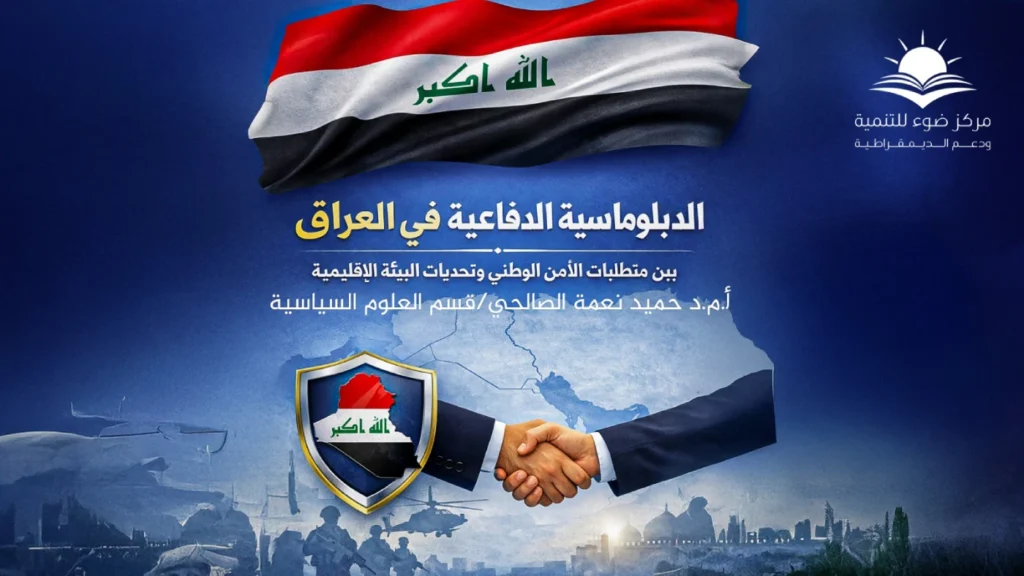
The regional system in the Middle East is undergoing accelerated security and political transformations, which are directly reflected on the nature of the challenges facing the state, including Iraq. In light of this complex regional environment, Iraq faces a set of security challenges that require ensuring national security. This necessitates employing diplomatic tools and mechanisms, foremost among them defensive diplomacy. Hence comes the importance of analyzing the reality of defensive diplomacy in Iraq, and clarifying its role in meeting the requirements of national security, in addition to diagnosing the most prominent challenges imposed by the surrounding regional environment. According to the following axes:
First Axis: The Concept of Defensive Diplomacy and Its Goals
Defensive diplomacy can be defined as a type of peaceful international activity based on dialogue and cooperation, practiced within bilateral or multilateral security organizations or by multiple parties, and represented by the Ministry of Defense, institutions, and affiliated forces with allies and neighboring or friendly states. It also includes the possibility of using armed forces in a peaceful manner, by individuals of the Ministry of Defense, civilians and military personnel. It also includes military education and research and development centers affiliated with the Ministry of Defense, in addition to cooperation of defense industries, and the exchange of knowledge, skills, and military equipment within the framework of cooperation between states. It is also defined as wars being known as a means of determining the strategic position to enable the state to deal with military threats. Accordingly, the success of this type of diplomacy depends on a balance of power between the two states, the internal front, and political leadership alike (1).
As for the goals of defensive diplomacy, and since it is one of the tools of the state with a non-violent character, its goals are represented in defusing conflicts and building bridges of trust between states, as well as employing military cadres on the peaceful side, and seeking to create stability and cooperation between states. It also serves the implementation of state deterrence objectives to consolidate the balance of power between states, and through that defensive diplomacy ensures the internal front and the political system. It is possible that defensive diplomacy has an important role in resolving conflicts and efforts to maintain peace, thus constituting a fundamental element in
The foreign policy of any state allows the employment of military and diplomatic resources to enhance the interests of national security.(3)
Second Axis: Defensive Diplomacy and Its Relationship to National Security
Since national security is the state’s ability to protect its sovereignty and the unity of its territory, and to secure its political and social stability, and to preserve its strategic interests; therefore, defensive diplomacy emerges as one of its most prominent elements, as it works to coordinate between the higher policies of the state and defense policy. Thus, achieving national security requires activating defensive diplomacy and involving the ministries of defense and foreign affairs, as well as working to prevent conflicts before they occur, and to reduce misunderstandings, which contributes to reducing the chances of external threat to national security.(4)
And since domestic policy is a reflection of foreign policy, the process of achieving diplomatic balance between the state units must be carried out through multiple tools and means such as (dialogue, military force, traditional or non-traditional diplomatic tools), which are employed through state policy to achieve its supreme goals, by exerting pressure on borders, communities, and individuals (influencers), which constitute the main driver for achieving the supreme goals of the state in the external environment. Hence, the state’s possession of traditional military capabilities leads to achieving a balance of interests to deter threat, and therefore the capabilities possessed by the state must be employed in its foreign policy through defensive diplomacy and the requirements of functional interest.
Accordingly, defensive diplomacy seeks to preserve national security through foreign policy, as foreign policy and defensive policy overlap in a complex and intertwined manner; through general coordination between foreign policy and defensive policy, it is possible to manage what is required to build armed forces and support them, such as providing weapons, equipment, and military supplies manufactured in other countries, or obtaining military bases, or any other facilities needed by armed forces outside national territory, shaping global public opinion toward the armed conflict before it begins, and working with international and regional organizations involved in resolving armed conflicts, in order to obtain the best results from resolving armed conflicts. It can be said that foreign policy and military policy (defensive) are closely linked, as both are related to external pressures, to borders and territory, and both are concerned with the intentions and capabilities of other states, which aspire to practice some form of power.(5)
Third Topic: Iraq’s Procedures in Employing Defensive Diplomacy to Enhance National Security
In light of a turbulent regional environment and intertwined security challenges, Iraq has moved toward employing defensive diplomacy as a supporting tool for security policy, with the aim of enhancing national security, preserving sovereignty, and reducing the effects of regional and international conflicts on the Iraqi interior. This defensive diplomacy has embodied a set of practical measures that the Iraqi state has taken at the bilateral, regional, and international levels.
Accordingly, Iraq has taken multiple measures to enhance military cooperation with a number of states, represented in:
• Signing defense and security cooperation agreements: The visit of the Iraqi Prime Minister Mohammed Shia’ Al-Sudani in the year 2025 to Britain included the signing of important agreements aimed at enhancing security and military cooperation between the two countries, in steps aimed at strengthening Iraq’s stability and developing its security and defense capabilities. It included developing the Habbaniyah Air Base in Mosul, which is a project valued at 500 million pounds sterling to modernize the air base in northern Iraq, which enhances the air defense system. It also included signing a contract worth 330 million pounds sterling with British companies to remove mines in affected areas, which enhances the security and safety of citizens. It stipulated supplying Iraq with security technology, and this is through providing advanced communications equipment and border control technologies, along with comprehensive training programs to support the Iraqi Ministries of Interior and Defense.(6)
• Building military capabilities and armament through international cooperation: In this context, there were steps by the current Iraqi Prime Minister Mohammed Shia’ Al-Sudani, such as Iraq signing an armament deal to purchase 41 aircraft, after Al-Sudani met with the former American President Joe Biden in the White House, and it is a military deal valued at (500) million dollars, despite it being objected to by some Iraqi political forces, because previous cooperation with the current American side did not have benefits to be mentioned. The Prime Minister also met, during his visit to the United States of America, with the Executive President of the company “Lockheed Martin”, which is the company responsible for manufacturing F-16 aircraft, and confirmed
According to a statement issued by his office, the importance of the company’s commitment to opening a center for the maintenance of modern aircraft and working on providing the spare materials for it was emphasized, due to the importance of this matter related to qualifying the aircraft and preserving the security of the country. The president of the company affirmed his understanding and readiness to respond to the requests of the Iraqi government related to implementing the provisions of the contracts for supplying aircraft to Iraq, and providing the related requirements.(7)
• Employing defensive diplomacy in combating terrorism: Iraq has sought since 2014, through its diplomatic effort, to play a pivotal role in combating ISIS terrorist gangs. The Iraqi government has stimulated the international community to form an international coalition to combat terrorist organizations, and to increase security cooperation and coordination to support, arm, and train Iraqi forces in all their صنوف to stand against terrorism. This was achieved through three forms:
1- The first form is represented in cooperation within the framework of the Arab League, as the efforts of Arab states reached agreement to conclude the Arab Agreement to Combat Terrorism, and that in the Council of Arab Interior and Justice Ministers.
2- The second form relates to participation in coalitions that bring together a number of Arab states alongside regional and international powers with the aim of combating terrorism. Among the most prominent of these is the participation of many Arab states in the international coalition led by the United States of America to combat ISIS in Iraq and Syria, among them: Egypt, Bahrain, Iraq, Jordan, Lebanon, Morocco, Kuwait, Oman, Qatar, the United Arab Emirates, and the Kingdom of Saudi Arabia.
3- As for the third form of cooperation, it is represented in bilateral agreements between Iraq and a number of Arab states. There is cooperation between Iraq and Syria, and between Iraq and Jordan, and between Iraq and Egypt, and agreements between Iraq and Morocco. These agreements included cooperation in the field of exchanging intelligence information, exchanging expertise, and providing assistance to Iraq in the field of combating ISIS.(8)
• Activating the role of military attachés: There are many Iraqi military attachés sent to countries of the world, and Iraq also receives many military attachés from different states. The Assistant Chief of Staff of the Army for Administration, Lieutenant General Saad Mazhar Al-Alaq, received the French military attaché in Baghdad, Brigadier General (Geoffroy Bina). During the meeting, the tools of joint cooperation between the two countries were discussed, regarding what relates to human resources management, and the French attaché (Bina) affirmed
Real cooperation is achieved by developing the frameworks of joint cooperation between the two countries in the military field; however, no official agreement was reached between the two countries regarding a military or security issue.(9)
The Ambassador of the Republic of Iraq was also received at the Holy See by Cardinal Pietro Parolin, Secretary of State, Rahman Farhan Al-Amari, on Wednesday 9/4/2024. He also met the Chief of Staff of the Army on 21/12/2023, the German military attaché accredited to the Republic, and discussed aspects of joint cooperation. These meetings reflect the role of military attachés in activating defensive diplomacy in Iraq.(10)
Accordingly, it can be said that Iraq has followed several measures to activate diplomacy and defense to achieve its national security and stability.
Fourth Axis / Challenges of the Regional Environment and Their Impact on Iraqi Defensive Diplomacy
In reality, the Middle East region is one of the most unstable regions, as it witnesses continuous armed conflicts, ongoing regional wars, and intertwined crises. And because of the important and vital geographical location of Iraq, it places it in the heart of tensions and crises, especially since it is bordered by the Islamic Republic, which is experiencing continuous conflicts with the United States of America, and (the Zionist entity). Therefore, Iraq represents an arena of intervention for the interests of regional and international powers. This places a heavy burden on Iraqi defensive diplomacy to maintain balance and avoid involvement in regional conflicts. This requires Iraqi defensive diplomacy to achieve balance between defensive and regional and international interests, and for Iraq to expand its defensive partnerships, and not align with one party, and to adopt a policy of defensive balance in its relations with regional and international powers. However, it still faces the challenge of maintaining balanced relations and not becoming involved in regional conflicts, and protecting internal national security.
Especially since the region has witnessed, during recent years, major transformations, including rapprochement of some Arab states with the Zionist entity, and the return of Saudi-Iranian relations, in addition to the relative withdrawal of the United States of America from some files. All these changes have reshaped balances of power, and Iraq finds itself compelled to reassess its policies in a manner consistent with these developments, without losing its balance or turning into a subordinate of one party at the expense of another.(11)
Accordingly, and due to Iraq’s position and its direct linkage to regional tension, it has become obligated to activate defensive diplomacy and expand its defensive partnerships, which requires readjusting defensive foreign policies in a manner that ensures the protection of national sovereignty and avoids turning Iraq into an arena of conflict.
Conclusion
It can be concluded from what has been presented that defensive diplomacy represents a pivotal tool in enhancing Iraqi national security, especially in the fields of building military capabilities, combating terrorism, and achieving balance in defensive foreign relations. However, the effectiveness of this diplomacy remains dependent on Iraq’s ability to manage the challenges of the regional environment, especially regional conflicts, external interventions, and the multiplicity of non-state actors. Accordingly, developing a clear national strategic vision for defensive diplomacy, based on diversifying partnerships and enhancing strategic independence, constitutes a fundamental condition to enable Iraq to protect its national security and preserve its sovereignty amid accelerated regional and international transformations.
List of Sources and References
1- Ali Hussein Hamid, Dr. Firas Abbas Hashem: The Geopolitical Dimensions of Iraqi Defensive Diplomacy: Toward a New Approach in Foreign Policy. Journal of Political Issues, issue (69), College of Political Science, University of Tehran, 2022, p. 369.
2- Hassan Al-Husour, Defensive Diplomacy: A Study in the Origin of the Concept and Its Uses. Center for Arab Research and Policy Studies, 2023, p. 13.
3- Rashid Jasim, Defensive Diplomacy: The Soft Face of Hard Power. Diplomatic Series, No. 1, Dar and Bookstore of Adnan, Baghdad, 2025, p. 89.
4- Mabrouka Ahmed Al-Roufiqi, Military Diplomacy: Defense in Times of Peace. Scientific Research Journal, issue (6), Africa University for Applied Humanities Sciences, 2018, p. 125.
5- Wael Al-Saadoun, The Relationship between Defensive Policy and Foreign Policy. Strategic Studies Center, Turkey, 2022, p. 8.
6- Iraqi Affairs, Iraqi-British Agreements to Enhance Security and Defense on the Website:
www.iraqi.military.capabilities
7- Dr. Intisar Rashid Zuroor and Dr. Dhan Faleh Hassan, Defensive Diplomacy and Its Impact on Iraqi National Security. Iraqi Journal of Political Science and International Relations, special issue of the conference, 2024, College of Political Science, Al-Mustansiriya University, p. 168.
8- Mustafa Kamal Al-Douri, The Strategic Role of Experience in Combating Terrorism in Iraq: A Periodic Study. Journal of Strategic and Political Studies Center, Egypt, 2025, p. 118.
9- Intisar Rashid Zuroor and Dr. Dhan Faleh Hassan, previously mentioned source, p. 169.
10- Embassy of the Republic of Iraq in the Vatican: the Iraqi Ambassador Al-Amari meets the Iraqi military attaché accredited to the Italian Republic, on the electronic website, and the other website:
https://mofa.gov.iq/vatican/?p=6582
https://www.facebook.com/mod.mil.iq
11- Al-Hussein Al-Samaki, Iraq between regional tension and political transformations, an article published on the electronic website:
https://shafaq.com/ar/