Formal and Informal Education
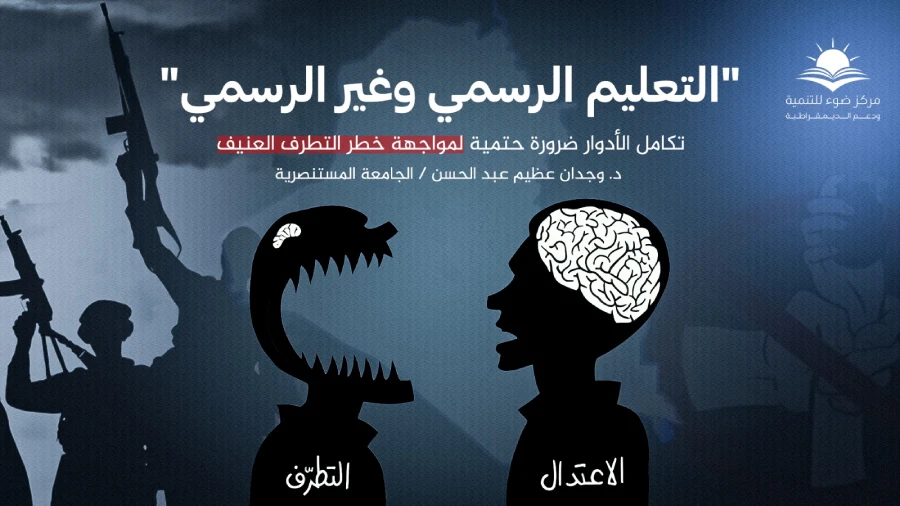
Formal and Informal Education: Effective Tools to Confront the Phenomenon of Extremism
The role of education in building awareness and confronting intellectual extremism
Extremism represents a serious threat to the security and stability of societies, as it contributes to the spread of violence, hatred, and intolerance, and undermines the foundations of peaceful coexistence among individuals. With the increasing spread of extremist ideologies, especially among youth, the need to confront this phenomenon has become more urgent than ever. Education, in its formal and informal forms, is considered one of the most important tools capable of confronting intellectual extremism, through building awareness, strengthening values of tolerance, and developing critical thinking.
Extremist groups often target youth, particularly those who suffer from marginalization, poverty, or lack of educational and social opportunities. These groups exploit ignorance, frustration, and weak awareness to spread their destructive ideologies. Therefore, education plays a fundamental role in immunizing individuals against extremist thought, by equipping them with knowledge and skills that enable them to distinguish between sound ideas and destructive ideologies.
Formal education, represented by schools and universities, plays a central role in promoting values of moderation, dialogue, and acceptance of others. Through educational curricula, concepts of citizenship, human rights, and respect for diversity can be instilled. Educational institutions also contribute to developing students’ critical thinking skills, enabling them to analyze information, question ideas, and reject blind indoctrination. This helps in building balanced personalities capable of positive interaction with society.
In addition, teachers and educators have a major responsibility in guiding students and addressing extremist ideas within classrooms. Training teachers on how to handle intellectual deviation and respond to extremist discourse is an essential step in confronting this phenomenon. Educational activities, discussions, and workshops also provide students with opportunities to express their opinions freely and learn the principles of constructive dialogue.
Informal education, on the other hand, includes all learning that takes place outside the official educational framework, such as family upbringing, religious institutions, media, and civil society organizations. This type of education plays a complementary role to formal education in shaping values and behaviors. The family is the first environment in which the individual acquires values, and it plays a major role in instilling tolerance, love, and respect for others.
Religious institutions also have an important role in spreading moderate religious discourse and correcting misconceptions exploited by extremist groups. Through sermons, lessons, and religious guidance, these institutions can promote a correct understanding of religion based on moderation and rejection of violence.
The media and social networks have become powerful tools in influencing public opinion, especially among youth. They can be used positively to spread awareness and counter extremist discourse by presenting balanced content that promotes dialogue and peaceful coexistence. Civil society organizations also contribute through awareness campaigns, workshops, and cultural activities that promote values of peace and social cohesion.
The integration between formal and informal education is essential to ensure a comprehensive approach in confronting extremism. Formal education alone is not sufficient if it is not supported by family and societal efforts. Likewise, informal education needs a solid educational foundation to reinforce its messages. Cooperation between educational institutions, families, religious institutions, and the media is therefore necessary to build an integrated system to confront intellectual extremism.
Confronting extremism requires a comprehensive strategy based on education in all its forms, as education contributes to building awareness, strengthening values, and developing critical thinking. It is considered the most effective weapon in protecting societies from the dangers of extremism and building a future based on peace and coexistence. Its contribution is represented in:
Developing critical thinking among students by teaching them how to analyze information, evaluate ideas, and reject blind indoctrination without examination.
Enhancing positive citizenship values by promoting concepts of human rights, tolerance, and peaceful coexistence.
Spreading a culture of dialogue and accepting others, through educational activities and curricula that encourage discussion and respect for differing opinions.
Empowering youth by providing educational and professional opportunities that reduce marginalization and exclusion, which limits their susceptibility to extremist ideologies.
Providing support to families and parents through awareness programs that help them guide their children and monitor their intellectual and behavioral development.
Integrating topics related to combating extremism within school curricula, in a way that highlights the dangers of extremism and its negative impacts on individuals and society.
Training teachers and educators on methods of addressing extremist ideas within classrooms and guiding students toward correct understanding.
Activating the role of religious institutions in presenting moderate religious discourse and correcting misconceptions that are exploited by extremist groups.
As for informal education, it plays a strong role in addressing behavioral and emotional aspects, through its importance in strengthening moral values and social bonds, which formal curricula alone cannot achieve. This is done through:
The role of the family in instilling values of love, tolerance, and respect for others, and guiding children toward positive interaction with society.
Strengthening social solidarity through community activities that promote cooperation and participation and reduce feelings of isolation.
Providing open spaces for dialogue to discuss issues related to extremism and violence, in cultural forums and youth organizations, where youth can express their opinions freely and safely.
Confronting extremist content on the internet and social media through digital awareness and promoting positive digital discourse.
All of this contributes to building strong societal immunity against extremist ideologies, by creating a generation that possesses knowledge, awareness, and critical thinking skills, and is capable of rejecting violence and extremism and building peace.