
Prof. Dr. Abdul-Ameer Abdulhassan Ibrahim - PhD in International Studies / Political Science
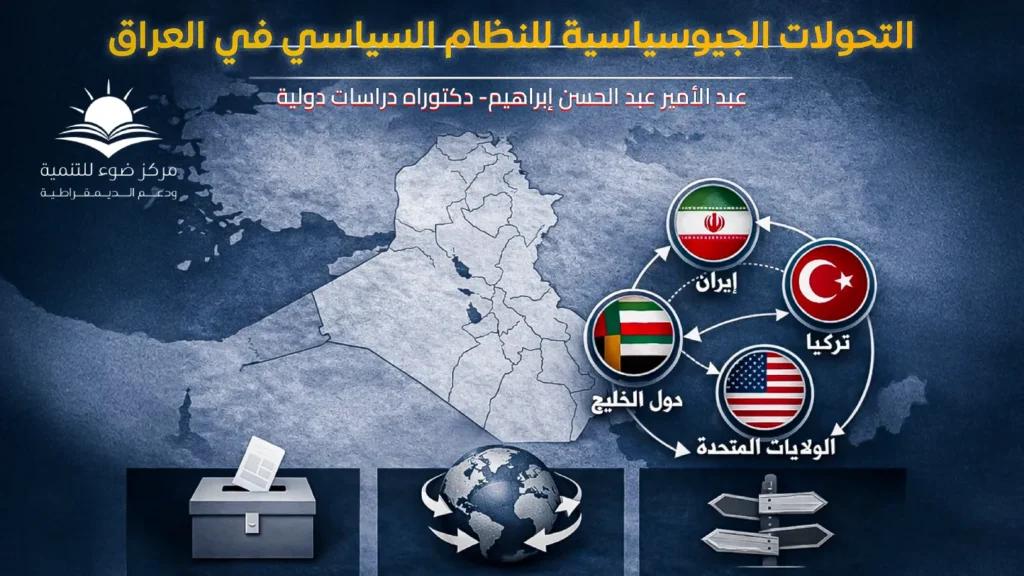
Geopolitical Transformations of the Political System in Iraq: A Study of Foreign Relations After the 2025 Elections
Abstract of the research
The research focuses on the political repercussions of the results of the 2025 elections on Iraq’s external behavior at the international and regional levels.
The research assumes that the parliamentary dominance of forces close to Iran, which the elections produced, will constitute a sharp shift in the equation of cautious balance adopted by previous governments.
The problem of the research lies in the clash of political references within the structure of the political system in Iraq after the October 2025 elections, and what results from that in terms of reshaping the geopolitical identity of the state.
The research discusses four main axes: structural clash with the United States, strategic integration with Iran, cautious geopolitical openness toward the Gulf states, and the sovereignty dilemma with the geographical neighborhood (Turkey, Syria, and Jordan).
The research concludes that Iraqi foreign policy will suffer after the new government formation from a new duality of discourse between an ideological parliament and a pragmatic government, reflecting a hybrid geopolitical identity.
Introduction
The period preceding the October 2025 elections in Iraq represents one of the freest periods in the country, as the country suffered from a political blockage following the 2019 protests and the 2021 elections, which were characterized by a “breaking of wills” conflict among major political forces.
This deadlock led to the birth of a “services and reconstruction” reference government as an interim solution to absorb street anger, but it continued to operate within a fragile legal environment until the 2025 elections came to establish a new political reference.
The results produced a clear dominance of “coordination framework” forces and their allies through a system that contributed to reducing the representation of independents, which led to the transfer of power from competing pluralities to a “consensual majority” that controls the joints of legislation and execution.
The research problem emerges in that this absolute parliamentary empowerment of forces adopting an ideological discourse hostile to the West may collide with the necessities of the realistic state imposed by Iraq’s obligations with the international system and the American Federal Reserve.
The close link between the results of these elections and the “sovereignty dilemma” places us before a question about how the state manages its conflicting references (ideological versus pragmatic) in light of the transformations of the geographical neighborhood.
The political system in Iraq after the October 11, 2025 elections appears as a test of conflict between the ballot box legitimacy and the power of reality. These elections have produced a new “political reference” based on service pragmatism, in contrast the “ideological reference” produced by the Coordination Framework. This contrast makes Iraqi foreign policy move forward on two fronts, as Baghdad seeks to تثبيت its independence through economic projects, while a parliamentary bloc with axis-aligned ambitions tends toward a regional alignment.
Importance of the research
The importance of the research is evident in its attempt to track the features of the critical transitional phase through which the Iraqi political system is passing, and this importance is distributed across two aspects:
First: theoretical importance:
1- Rooting the concept of the “new political reference”: the research contributes to providing a theoretical framework to understand how the legitimacy of the political system shifts toward “consensual administrative and service-oriented” legitimacy.
2- Analyzing the dynamics of dual sovereignty: the research enriches political thought through a comparison of how the state coexists with a parallel authority that possesses legislative cover.
3- Re-reading international and regional balances: clarifying the nature of interaction with the new balances of state forces after the October 11 war at the international and regional levels.
Second: practical importance:
1- Guiding foreign decision-making: providing a roadmap to balance parliamentary pressure with international financial and monetary requirements of the state.
2- Evaluating geopolitical and economic opportunities: presenting a feasibility study of strategic linkage projects (Development Road) within a new political environment governed by ambiguity.
3- Security and political foresight: developing future scenarios that help sovereign institutions prepare for various contingencies and protect civil peace.
Research objectives
The research seeks to analyze the political reference for the year 2025 and its implications for foreign decision-making, and to evaluate the future of relations with the United States in light of the need for the financial sector, and with Iran in the context of social and ideological relations, and to monitor the state of “ambiguity and contradiction” in the relationship with Syria after the end of the Assad regime, and to reach insights into the paths of the political system (2026–2030).
Research problem
The research problem is represented in the clash of references within the structure of the Iraqi political system that was produced by the October 2025 elections, where the results produced a duality in decision-making:
An executive governmental reference: adopts a service-oriented pragmatic approach focused on “reconstruction and services” and requires financial stability linked to the international system (the dollar and the Federal Reserve).
A legislative parliamentary reference: dominated by an ideological majority that tends toward axis alignment and rejects the American presence, placing the state in a condition of “dual sovereignty” as worrying.
The main question: how can the Iraqi state achieve compatibility between the requirements of economic and service stability and ideological pressures and accelerating transformations in neighboring countries (especially Syria after the fall of the Assad regime)?
Research hypothesis
The research starts from a main hypothesis: that the ability of the Iraqi political system after 2025 to achieve service and security stability is dependent on the success of the executive authority in neutralizing (service reference “reconstruction”) from ideological parliamentary conflicts. From this, the following hypotheses emerge:
• Iraq’s success in openness toward the Gulf states, Jordan, and the new Syria depends on prioritizing geopolitical interests over ideological considerations.
• Any direct clash between parliament and the international financial system (Washington) will necessarily lead to the collapse of the “service reference” and the return of popular protests.
Research methodology
To achieve the research objectives and test its hypotheses, reliance was placed on an integration between three scientific approaches:
• The systems analysis approach: studying the interactions between inputs (October 2025 elections), outputs (foreign policies), and feedback, and how state institutions operate within conflicting references.
• The political realism approach: analyzing Iraq’s relations with major international powers (the United States and Iran) and neighboring countries, as relationships based on interests and field power.
• The foresight approach: building future scenarios (consensus, clash, stalemate) based on available data, and presenting policy recommendations to decision-makers.
Geopolitical transformations after the parliamentary elections
First: the geopolitical transformation in the relationship with the United States: from partnership to “tense containment”
The relationship with the United States represents the first variable to measure the extent of the independence of Iraqi geopolitical decision-making after 2025. On one hand, the Iraqi government shows a clear orientation toward maintaining a “service reference” that requires integration into the global financial system, while on the other hand, the parliamentary ideological reference pushes toward severing ties with Washington and rejecting normalization with the West.
This transformation reflects the desire of dominant forces to redefine national interest, far from the American security umbrella, which will face challenges, as follows:
a. The security equation: the geopolitical transformation generates parliamentary pressure to end the American military presence, which collides with the Iraqi forces’ loss of air defense capabilities and air intelligence systems.
b. Financial sovereignty: escalating tension with Washington exposes Iraqi foreign policy to the risk of American Federal Reserve sanctions, which places the Iraqi economy toward “the East”, amid fears of financial collapse.
This structural blockage in the relationship with the United States, and the increasing financial pressures through the Federal Reserve compliance platform, pushes the Iraqi decision-maker (driven by parliamentary reference) to search for geopolitical alternatives that secure the survival of the system, which enhances the acceleration of organic integration with the Iranian neighbor as an alternative strategic choice.
Second: the geopolitical shift toward Iran: from the neighborhood to organic integration
The Iraqi geopolitical shift toward the Islamic Republic of Iran goes beyond the limits of traditional diplomatic coordination after the October 2025 elections, to move to the stage of “organic integration”, as this shift is based on strategic compatibility between the dominant parliamentary political reference in Baghdad and Tehran’s vision of cross-border regional security, where Iraq is no longer seen in the new geopolitical perspective as merely a mediation arena, but rather turns into an economic depth and a basic strategic corridor in the Iranian regional strategy, which will focus on axes, as follows:
a. Unity of destiny: the harmony of the parliamentary reference in Baghdad with Tehran’s vision for regional security.
b. Economic integration: accelerating agreements to consolidate mutual dependence and break international isolation from the axis.
In conclusion, geopolitical integration with Iran will place Iraq before the choice of economic and political positioning, which will narrow the maneuvering space of the new government in the face of international pressures.
This organic bet will impose on the Iraqi decision-maker the necessity of searching for an economic safety valve through openness toward the Arab environment, specifically the Gulf states, to ensure the flow of investments and avoid financial suffocation.
Third: the geopolitical shift toward the Arab Gulf states: “pragmatic geo-economics”
The results of the 2025 elections impose on Iraq a geopolitical approach based on “neutralizing ideology” in dealing with the Arab Gulf states, where Iraq seeks to exploit its geographical location as a continental bridge linking East to West through major development projects.
This shift reflects the executive authority’s attempt to legitimize its pragmatism through the geopolitical factor to compensate for the deficiency in parliamentary legitimacy resulting from ideological polarization.
The success of geopolitical openness toward the Gulf will remain contingent on Iraq’s ability to maintain border security and dismantle the geographic determinants tied to neighboring states, especially in light of the dramatic transformations in the Syrian and Turkish arenas that impose new sovereignty pressures.
Fourth: the geopolitical shift and the equations of the geographical neighborhood (Turkey, Syria, Jordan)
The geographical neighborhood represents the most complex circle in Iraqi geopolitical transformations after 2025, where sovereignty files intersect with financial and security interests. At the same time, Iraq seeks to impose parliamentary hegemony, it finds itself facing sharp geopolitical contradictions with the new Syria after the fall of the Assad regime, and mounting Turkish field pressures that place the state before the challenge of redefining its national security borders, which will push the new government to adopt new equations for water negotiations with Turkey, and to work on addressing contradictions and ambiguity with the new Syria, and finding frameworks for cooperation with Jordan as a balance axis, as follows:
• Turkey and water security: a clash between parliamentary ideological discourse and field political reality, which makes the relationship hostage to difficult negotiations.
• Syria and contradictions: after the fall of the Assad regime, despite political transformations in Syria, the relationship remains marked by ambiguity and sharp contradictions, as a result of parliament’s apprehension toward the new Syrian transformations and the absence of previous ideological harmony.
• Jordan as a balancing axis: the survival of the pragmatic service reference makes Jordan a breathing diplomatic outlet and a balancing window to the Arab depth.
The state of ambiguity and contradictions that characterize the geographical neighborhood file (especially the Syrian file) makes the Iraqi geopolitical transformation an incomplete process in terms of pillars, which will necessitate the development of precise strategic scenarios to confront the possibilities of collision or political deconstruction.
Fifth: future scenarios of geopolitical transformations (2026–2030)
The trajectories of Iraq in the coming stage require bridging the gap between the requirements of political and security reality and financial and monetary constraints. Iraq today stands at a crossroads between maintaining internal stability and external alignment.
Future scenarios are built on how the state succeeds in containing contradictions between the executive service-oriented reference and the parliamentary ideological reference, and the impact of that on Iraq’s positioning in light of regional transformations, continuous American pressures, and entrenched Iranian influence.
Based on the conflicting references and regional transformations addressed by the research, three future paths emerge that determine the destiny of Iraq’s geopolitical positioning, as follows:
• Scenario of pragmatic compatibility: success of the government in managing conflicting references and maintaining financial and political balance with the international system.
• Scenario of axis alignment and collision: dominance of parliamentary ideology, leading to international financial isolation and sharp tension with the new Syrian reality.
• Scenario of instability: return of protests as a result of the failure of the service reference to achieve tangible living improvement.
Iraq’s geopolitical transformations after 2025 indicate that Iraq is entering the stage of strategic repositioning.
This geopolitical transformation will not be completed unless duality of political decision-making is ended and the dominance of ideological reference is replaced by a national reference that ensures Iraq’s survival as an active state in its regional environment and not merely a field for settling accounts.
Conclusion and findings
The research concluded that geopolitical transformations in Iraq after the October 2025 elections have placed the political system in Iraq at a historic juncture, where the elections succeeded in establishing a stable political reference procedurally, but they produced a structural division in political decision-making.
The most important conclusions reached by the research can be summarized as follows:
1- Duality of political decision-making: the results produced a reality in which there is a “head” of the state represented by an executive government that searches for legitimacy through services and reconstruction and global financial integration, and a “legislative head” driven by an ideological reference that tends toward absolute axis alignment.
2- The organic bet on Iran: the research proved that the Iraqi geopolitical orientation toward Iran has become a structural option as a result of the dominance of parliamentary ideology and the reduction of the American Federal Reserve lever.
3- Strategic ambiguity with the new Syria: the study revealed that the fall of the Assad regime opens the door to organic integration as expected, but rather produces a state of geopolitical ambiguity and strategic ambiguity in relations with the new Syrian leadership, as a result of the absence of previous ideological harmony and the clash of border interests.
4- Decline of the mediation role: Iraq’s transformation from a regional mediator to an interacting party reduces its ability to perform diplomatic roles between Iran and the United States.
5- That balancing power through parliamentary forces will produce a hybrid geopolitical identity that places Iraq as an influential regional center in shaping regional policies.
Recommendations
Based on what has been presented, the research comes out with a set of recommendations, as follows:
1- The necessity of finding a legal framework that obliges parliament and the government to place ceilings for consensus in foreign policy to prevent contradiction between geopolitical axes and state commitments.
2- Adopting geographic pragmatism with Syria: the necessity of building a relationship based on security and border interests only with the new Syrian leadership, away from ideological polarizations.
3- Establishing a joint operations room between the Central Bank, the Ministry of Foreign Affairs, and parliamentary committees to monitor the movement of the dollar and avoid uncalculated clashes with the international financial system.
4- Diversifying security and economic partnerships in a gradual manner to reduce total dependence on the American sector through partnerships with other international powers (Russia, China, Russia) without entering into ideological axis policies.
Sources
Arabic sources:
المركز العراقي للدراسات الاستراتيجية. (2025). أثر نتائج انتخابات 2025 على التوازن الإقليمي للعراق. بغداد.
مجلة السياسة الدولية. (2025، كانون الأول). التحولات الجيوسياسية في المشرق العربي مابعد عقوبات قيصر. مؤسسة الأهرام، القاهرة.
مركز الإمارات للدراسات والبحوث الاستراتيجية. (2025). آفاق التعاون الخليجي-العراقي في ظل مشروع طريق التنمية. أبو ظبي.
وزارة الخارجية العراقية. (2025). التقرير السنوي حول دوائر الجوار الجغرافي: التحديات والفرص. بغداد.
Foreign Sources:
Chatham House. (2025). The Sudani Doctrine: Balancing Services and Sovereignty in Post-Election Iraq. London: Royal Institute of International Affairs.
Council on Foreign Relations (CFR). (2025). U.S.-Iraq Relations in 2026: From Military Presence to Financial Compliance. New York.
Foreign Policy Magazine. (2025). The Syrian Shift: How Damascus is Redrawing its Borders with Baghdad.
International Crisis Group (ICG). (2025). Iraq’s 2025 Elections: Managing the Transition to Consensual Hegemony. Brussels.
Mansour, R. (2025). Iraq’s Geopolitical Pivot: The Struggle Between Ideology and Pragmatism. Middle East Policy Journal.