
Ways to Combat Extremism and Violent Extremism
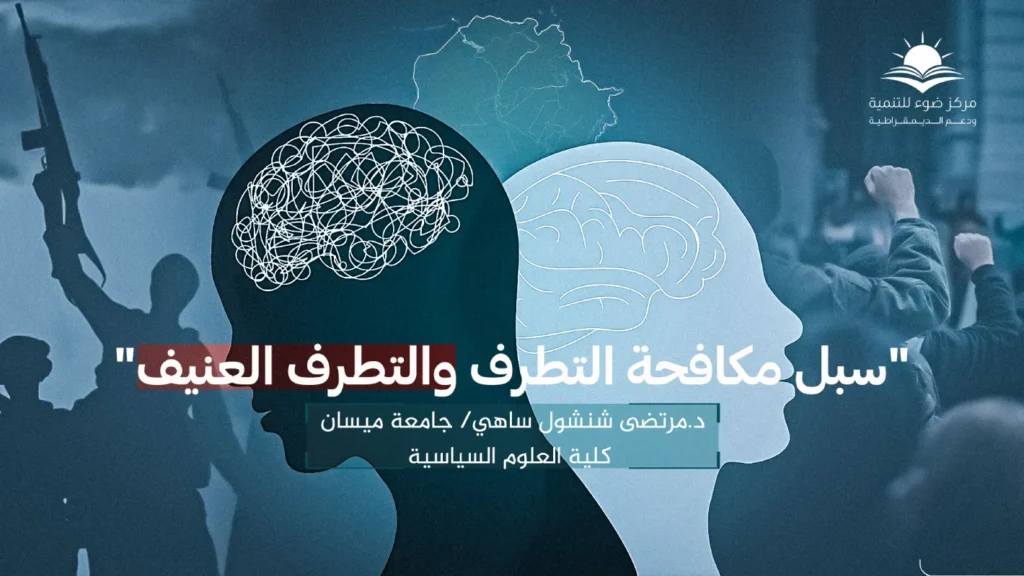
Ways to Combat Extremism and Violent Extremism
Prof. Dr. Murtadha Shanshal Sami / University of Maysan – College of Political Science
Violent extremism has spread like cancer and is striking many parts of the world, representing a serious threat to the international community due to its dangerous consequences that threaten societal peace and hinder the resolution of civilizational and cultural problems. The international community has expanded its awareness of the danger of extremism associated with terrorism, which emerged on the Iraqi scene after 2003 and began to impact the state, political institutions, and the security of the people’s future. Therefore, efforts were made to combat all forms of extremism militarily through an international coalition led by the United States, supported by coalition parties and the international community, in support of Iraq in its war against terrorism.
The violent extremism mentioned differs from one country to another according to its nature and policies. It aims to instill fear within society or governments to force them to act or refrain from reform, or to create social disruption. Violent extremism spreads a culture of terror by using technological and scientific tools and all governmental and visual media outlets to promote its goals, which may be implemented through armed methods such as killing, displacement, destruction, or genocide. Therefore, all countries that have experienced this phenomenon have worked to eliminate all forms of terrorism and extremism, as combating it is a necessary obligation and requires commitment to preventing its practices or the crimes on which it is based.
This armed extremism that afflicted the Iraqi body in particular after 2003—whether its source was external or internal—emerged due to a number of factors, the most prominent of which are:
1. The sectarian and ethnic political quota system established by the United States after the occupation of Iraq, as if it were a regional solution addressing transformations from state transition to a legal framework for the economy. This accompanied the American occupation process and transformed it into a driver of political development from within, producing new legitimacy and a shift in strategies for political gain, to the point that the national reconciliation project turned into a project for managing forced reconciliation among political factions.
From this standpoint, the ruling elites worked to politically employ sectarianism and religion through slogans, rituals, and practices that were materially and morally supported to win the struggle against others. This led to dressing social division in a political form through various movements, organizations, and entities.
2- The sectarian war in Iraq in 2006 brought violent extremism to very advanced stages, as the revenues of millions of terrorists increased. The American occupation also contributed to increasing the efforts exerted by the government to reduce the intensity of sectarianism in political conflicts. After 2011, political crises escalated rapidly, leading to a series of protests and security objections that were among the reasons for the return of terrorism, in addition to the existence of a suitable environment for the concentration of extremist terrorist elements after 2014 under the name of the Islamic State in Iraq and the Levant (ISIS), supported strongly by some Sunni tribes who claimed sectarian marginalization, which ultimately led to their attack on Mosul on June 10, 2014, and subsequently the return of the threat of terrorism once again.
3- The military interventions of the United States in Iraq and other countries had a major impact on the emergence of the phenomenon of extremism, as they succeeded in achieving an advanced level of chaos, to the extent that they invalidated the assumption that foreign intervention could bring the democratic system desired by the people.
This intervention and the support of extremist groups were, in many cases, accompanied by regional support for these groups, including what the Kingdom of Saudi Arabia provided in terms of money, weapons, and human gatherings, which it explicitly announced on more than one occasion.
4- The new international strategic orientations and organizations led to prioritizing rapid military solutions and attention at the expense of neglecting civil aspects (cultural, economic, and others), with excessive emphasis on relying on extremist discourse and military methods in managing state affairs or outside the framework of the state at all levels, amid multiple conflicts and justifications.
This armed violence associated with internal and external problems has not ended to this day. Rather, it can be said that the intensity of this violence has decreased or declined in light of many governmental and social policies and procedures adopted under frameworks or slogans of restoring security and stability to devastated cities, and slogans of societal reconciliation through offering many commitments and concessions related to political or personal issues.
From here, it can be said that there is a set of policies or ways to combat extremism associated with carrying weapons, which can be addressed as follows:
1- Adopting clear mechanisms toward establishing national reconciliation to normalize political conditions, adopting comprehensive national dialogue, and building and strengthening a culture of institutional construction and institutional administration rather than personal (individual) administration for state institutions.
The reform of the political institution is the foundation for reforming the rest of the Iraqi state institutions. The more the ruling political structure is based on national pillars and objectives rather than motives for drawing certain policies, the more possible it becomes—if executive bodies are ready—to apply the drawn plans on the ground.
2- Working to stop religious and societal extremism that leads to armed terrorist acts by addressing internal and external interventions from the outset, and adopting historical solutions, which is certainly a long path. This includes combating rigid interpretations of halal and haram, reviving awareness that extremist groups under any name represent the destruction of the country and harm to people, and confronting the dark outlook that justifies acts of terrorism such as killing, destruction, intimidation, and terror. Not to mention the multiple international efforts to combat this terrorism. The shortest paths must be local, and this has been witnessed through the sedition and the rise of extremist religious figures, which compelled the religious authority in Najaf Al-Ashraf, represented by Sayyid Ali Al-Sistani, and Iraqi scholars to diagnose the true nature of terrorism and pressure other countries that harbor them in order to curb incitement.
3- The United States of America must be highly responsible and serious in combating extremist organizations and eliminating them in cooperation with the Baghdad government through establishing real joint working mechanisms, arming the Iraqi military forces with advanced technological weapons and equipment, and exchanging information and support on more than one level. Especially since the United States possesses the most advanced military systems, weapons, and funds, which it uses to spread chaos, preserve its interests, and keep Iraq weak and in constant need of its protection.
4- The educated elites must take their role in maintaining balance within society through integration and renewal of thought, making positive change its core axis. Through this, they carry out the process of change and development within society, as the success or failure of the political elite in performing its function depends on the role it plays in presenting a set of solutions to social problems. The capabilities of this elite and its awareness of its role in achieving development without resorting to change toward extremism and carrying weapons, as occurred in the events of October 2019, which initially proceeded on the correct path as protests against the deterioration of economic conditions, slogans, and protest behaviors. However, it soon deviated due to partisan and factional agendas, internal and external, as well as the failure of successive governments that had achieved relative security to correctly change the image of the state. This was done through security reforms far from the ideal image and the unethical manifestations that distorted the image of these protests.
5- Strengthening the spirit of citizenship and compliance with laws. On one occasion, King Faisal I stated: (I say, and I fully believe, that in Iraq there is a people who, if properly prepared, would be among the greatest peoples of the world in status and the most refined in qualities. However, they lack one thing, which is the government that should be from that people, for them, and that teaches them. What are the greatest efforts that must be exerted to complete this formation and this composition??).
At the level of citizenship, belief in it or lack thereof has become one of the most important factors of stability or instability of Iraqi society. The extent of the feeling of citizenship and comprehensive national identity indicates the unity of the social fabric, and thus its stability, which is ultimately reflected in security, distancing from extremism, and refraining from resorting to the use of weapons.
It is also necessary to emphasize the constitutionality of the provisions of laws related to terrorism and the commitment of the state within society to preserving societal security through strengthening international cooperation to combat terrorism.
6- Extremism and violent extremism can be confronted using the same style of its attack. Extremism can be confronted electronically, which leads to violent extremism, through defensive methods and electronic resistance, as well as through media means, as follows:
a- Blocking suspicious websites that seek to spread terrorism and extremist ideas, as well as websites that call for and inspire terrorism, aggression, and attacks on others.
b- Activating the supervisory role that addresses crimes of electronic and media terrorism by developing the mechanisms of institutions concerned with combating terrorism and media agencies.
c- Activating the media role in exposing the methods of social media networks and internet websites, and enforcing legal control at the level of the state or the global community in general.
In conclusion, it can be said that extremism and violent extremism cannot be reduced or eliminated except through the role of religious institutions, media, and education in presenting a balanced vision and correcting erroneous concepts, and through proceeding with the application of laws that criminalize terrorist activities and criminalize providing support to extremists, while not infringing on freedom of legitimate thought.
Sources:
1- Political Issues Journal, issue 37–38, Al-Nahrain University, College of Political Science.
2- Saadi Mahmoud Hussein, The Islamic State in Iraq, Al-Noor Scientific Library, Baghdad, 2012.
3- Adel Falak Al-Darraji, Firas Mohammed Al-Yas, Iraq in Crisis, Dar Al-Academy for Publishing, Amman, 2017.
4- Sinan Adnan and Aron Reese, Beyond the Islamic State, Institute for the Study of War, Report 24, (October 2014), pp. 10–13.
5- Osama Abed, Iraq Protests, published on 30/10/2019, published at the link:
http://www.arab48.com
6- Haider Ammar Yass, The Iraqi Identity Crisis under Occupation, Iraqi Journal of Political Science, Arab Unity Studies Center, Beirut, Issue 14, 2007.